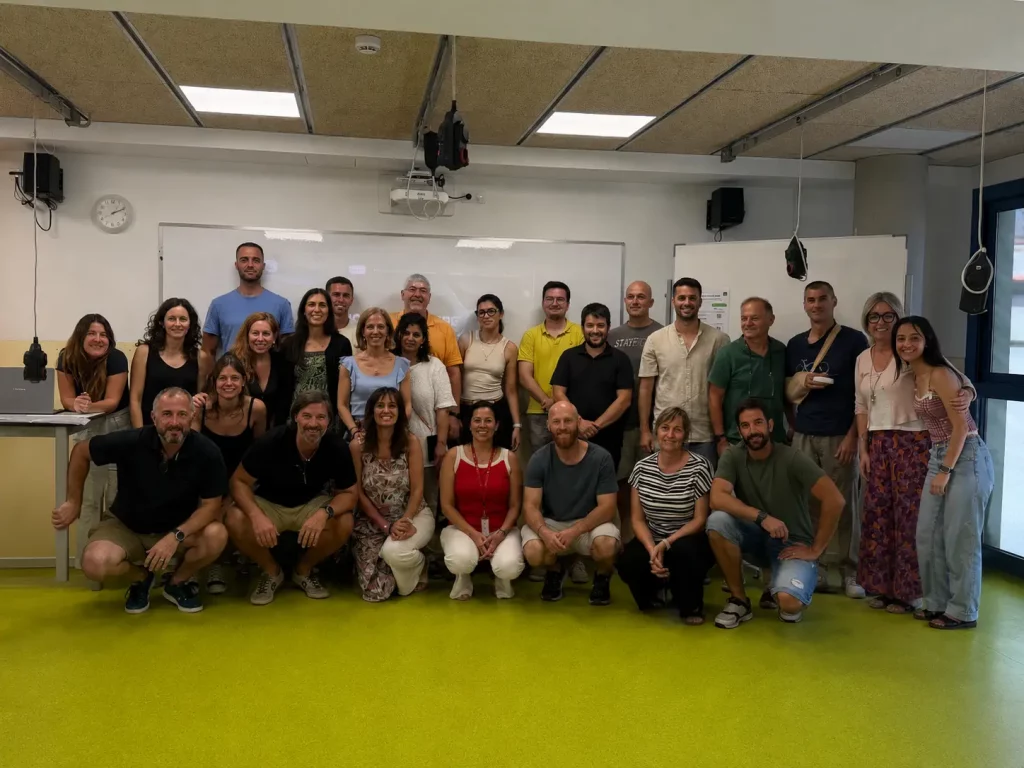
Local Trainings for Teachers and School Directors
The InclusiveFuture Local Trainings in Partner Countries
The local cascade trainings (Task 3.3) were implemented across 8 European countries – Bulgaria, Finland, Greece, Hungary, Portugal, Romania, Spain, and Türkiye – between May and June 2026, following the international mobility in Reus. A total of 20 local training sessions were delivered by the consortium’s partner organisations, each replicating the Reus training at the national level in local languages.
The Objective
The primary objective of the local trainings was to transition the “Change Agents” who attended the Reus mobility from learners into trainers, transferring the GreenComp Sustainability Competence Framework and the Inclusive Pedagogical Model to local teaching staff and school leadership. Each partner organisation was mandated to train a minimum of 20 local peers across two separate sessions in two different schools, ensuring a consortium-wide target of at least 200 newly trained educators.
The Participants & Target Group
The local trainings reached a total of 296 teachers, school directors, SEN specialists, and support staff, significantly exceeding the 200-educator target set in the Grant Agreement. The target group was intentionally broad and multi-disciplinary, encompassing primary, secondary and Vocational Education and Training (VET) teachers, Special Educational Needs (SEN) specialists, school directors, and school counsellors — reflecting the project’s “whole-school approach.”
The Sessions & Topics Covered
Each local training followed a standardised 25-hour blended learning framework, adaptable to face-to-face, online, or blended delivery depending on local context. Key components included:
Introductory Face-to-Face Sessions: Presenting the InclusiveFuture project, the GreenComp Framework, the Inclusive Pedagogical Model, and the structure of the MOOC.
Autonomous MOOC Study: Approximately 15–25 hours of independent online learning, often supported through peer-support groups and continuous facilitator contact (WhatsApp, email, individual consultations).
Practical Collaborative Activities: Including the Activity Planning Sheet and the Inclusion Challenge, connecting theoretical concepts to authentic classroom situations.
Micro-Teaching and Classroom Implementation: Peer-to-peer design and delivery of inclusive sustainability mini-lessons.
Reflection Sessions: Structured online or face-to-face discussions on implementation ideas and next steps.
Post-assessment data showed exceptionally high satisfaction across the consortium, with participants particularly valuing the practical, ready-to-use materials and the collaborative learning environment.
Looking Ahead
The successful completion of the local trainings marks the transition to the next phases of the Whole-School Approach Roadmap:
School Workshops: 4-hour practical workshops led by the trained Change Agents, targeting at least 100 additional school staff not reached by the initial training.
Community Laboratories: Community-facing activities involving children and parents.
Green Certification: A tiered Bronze/Silver/Gold certification model to recognise schools’ progress and feature them on a European digital map.